
Adding what the banks can't see — property, loans, savings certificates
Connected accounts are the easy half of net worth. The half that decides the number — the house, the mortgage, the certificates — has to be told once, and then it stays told.
By António Avelar Updated 22 August 2026 4 min read
Connecting your bank accounts gets you a balance. It does not get you a net worth, and for most households the difference is very large.
Net worth is everything you own minus everything you owe. Bank balances are usually a small share of both sides. The house is the biggest asset, the mortgage is the biggest debt, and neither of them appears in any account feed.
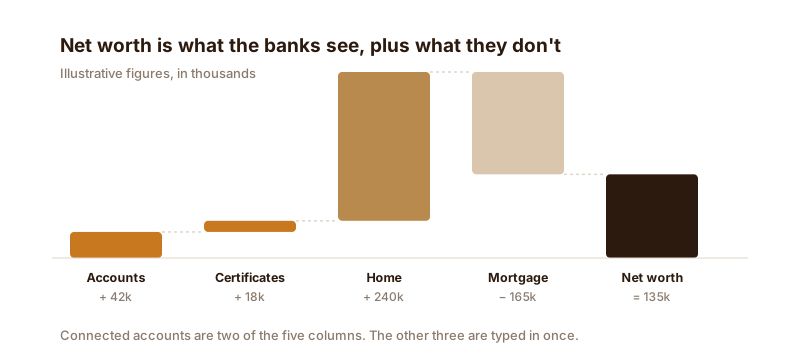
In the illustration above, connected accounts are two of the five columns. The other three are typed in once and then left alone.
The four things to add, in order of how much they change the number
1. The property. Under Settings → Assets & liabilities, add it as an asset with a name, a category and a value. The value is a judgement — use a conservative, defensible figure rather than the optimistic one, and revisit it once a year rather than every time you see a listing on your street. A number that is roughly right and stable is far more useful than one that is precisely wrong and jumpy.
2. The mortgage. Add it as a liability: name, lender, outstanding balance, interest rate and monthly payment. This is the entry that most changes the picture, and the one people most often skip because it is unpleasant. A net worth calculated without it is not optimistic, it is fictional.
3. Certificados de Aforro. If you hold them, connect your AforroNet account under Settings with your username, password and NIF, and the balance is fetched and kept current — including the interest, which is the part nobody tracks by hand. Tracking Certificados de Aforro alongside your bank accounts covers why they are awkward to follow otherwise.
4. Everything else worth over a few thousand. The car, cash, a private loan someone owes you, an asset held somewhere no software reaches. Same place as the property, and the same rule: conservative and stable beats precise and volatile.
Why entering it by hand is fine
There is a reflex that says anything typed in is second-class data. For net worth it is the opposite.
The things you type in are the things that move slowly. A house valuation is meaningful to within a few percent for a year at a time. A mortgage balance falls by a known amount each month. A car depreciates predictably. These are exactly the values where a once-a-year update is enough, and where automation would be solving a problem you do not have.
The things that move fast — accounts, cards, certificates — are the ones that connect. The division of labour lands in the right place.
What it changes once it is in
Three things become answerable that were not before.
The number itself. Most people are wrong about their net worth in both directions: they forget the mortgage, or they forget the property. Having both in one place tends to be a mild surprise, and occasionally a large one.
Whether a good month was actually good. Spending less means nothing on its own if the mortgage went up more. Net worth is the only measure that nets those against each other. How to work out your real net worth covers what belongs on each side and the common double-counts.
Whether paying down debt is beating saving. The comparison is only visible when both sides are in the same view — the falling balance on one side, the growing certificates on the other.
Two things to get right
Do not double-count. The classic version: adding the house at full value while also holding money you have earmarked for the mortgage as a separate asset. Each euro belongs in exactly one place.
Keep the valuation honest and boring. Update the property once a year, on a date you choose in advance. Revaluing whenever you feel good about the market turns net worth from a measurement into a mood.
When it is set up
Nothing. That is the point. The connected accounts stay current on their own, the certificates are fetched, and the three or four hand-entered figures need touching about once a year.
What you get in return is the figure that what a house actually costs per month is really about: the difference between what a property does to your monthly cash flow and what it does to your position. Those two answers frequently disagree, and only one of them is visible from a bank account.