
The Portuguese tax calendar, and the dates that decide your refund
Filing in April only reports what February confirmed. The dates of the Portuguese tax year in order, what each one asks of you, and why one of them is the only one that hurts.
By António Avelar Updated 22 August 2026 3 min read
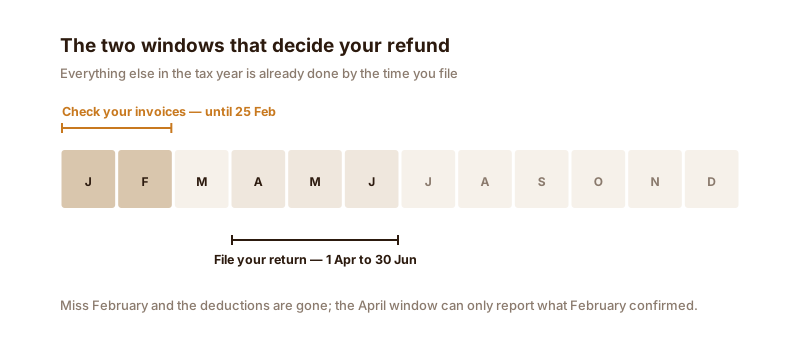
Almost everyone thinks about Portuguese income tax in April. By April almost nothing is still decided: the return pulls figures that were closed weeks earlier, and what is in them is what you confirmed — or failed to confirm — back in February.
The tax year has two windows that matter, and they are a long way apart.
The dates, in order
| When | What happens | What it asks of you |
|---|---|---|
| January | Last year’s invoices finish arriving from merchants | Start looking at the pending ones, without hurry |
| By 15 February | Household composition and personal details for last year are confirmed | Check who is in your household — it changes per-person deductions |
| By 25 February | e-Fatura invoice validation closes | Classify the pending invoices. There is no second chance after this |
| Mid-March | The tax authority publishes the deductible totals it calculated | Check them against what you actually spent |
| By 31 March | Deadline to dispute those totals | Complain, if a total is clearly wrong |
| 1 April to 30 June | Filing window | File. Early, if you are expecting a refund |
| By 31 July | Assessment | Receive the notice; check it |
| By 31 August | Payment, if you owe | Have the money available |
These dates have been stable for several years, but confirm them on the Portal das Finanças — a changed deadline is the one thing here that can move from year to year.
Why February is the date that hurts
Portuguese tax deductions — health, education, housing, care homes, general family expenses — are calculated from invoices issued against your taxpayer number and classified into the right sector. An invoice left pending in February counts towards nothing. There is no way to recover it in April.
And the part that catches people: a pending invoice is not a missing invoice. It is an invoice that exists, and whose sector the tax authority could not determine on its own. It sits waiting for someone to press a button. Nobody tells you.
February’s job, then, is short and specific: open the pending invoices and say what each one was. e-Fatura without the February panic covers using your bank statement to work out what they were — the slow part, because a pending invoice usually carries a company’s registered name rather than the name above the shop you walked into.
What to do the rest of the year
Nothing urgent, and that is the point. Two small things remove February’s work:
Ask for the invoice with your taxpayer number, every time. Especially health and education, where the deduction rate is highest. An invoice without your number does not exist for tax purposes.
Know where your deductible spending is before February arrives. The categories the tax authority cares about — health, education, housing, care — are visible on your bank statement all year. If your spending is already categorised, you reach February with a list of what you should have and can check whether it is all there, instead of starting from a context-free list of pending invoices. Using your statement to find the deductions you missed works through that matching in detail.
If you are new to filing here
Two things surprise people who have filed taxes elsewhere. First, the deduction system is invoice-driven rather than receipt-driven: you do not keep paper and submit it, you make sure the invoice was issued against your number and correctly classified at the time. Second, the window is genuinely fixed — the 25 February cut-off is not a soft deadline with a grace period behind it.
If a refund is a meaningful part of your year, what to do with money that arrives all at once applies directly: a large sum arriving once a year behaves like a bonus, and disappears the same way if it has no destination before it lands.