
What Revolut's spending breakdown can and can't tell you
Revolut's analytics are genuinely good, and they are also drawn from one account. Here is what that leaves out, and when it stops being enough.
By António Avelar Updated 22 August 2026 4 min read
Revolut’s Analytics tab is one of the better things any bank ships. It categorises as you spend, it draws a clean monthly breakdown, it tells you what you spent at a particular merchant last year, and none of it requires you to do anything. Compared to what most incumbent banks offer, it is not close.
It is also, structurally, a report about one account. That is not a flaw — it is what a bank’s own app is. But it produces a specific and consistent kind of wrong answer, and it is worth being able to name it.
The shape of the gap
For most people in Portugal, Revolut is the second card, not the first. The salary arrives at a main bank. The mortgage or the rent leaves from there. The utilities, the insurance, the gym and the phone are direct debits on that account because that is where they were set up years ago. Revolut gets the discretionary spending: the coffee, the travel, the online orders, the group dinner someone splits.
So a Revolut breakdown showing €640 for the month, 30% of it on restaurants, is entirely accurate and describes perhaps a fifth of your financial life — the fifth that was already the least surprising.
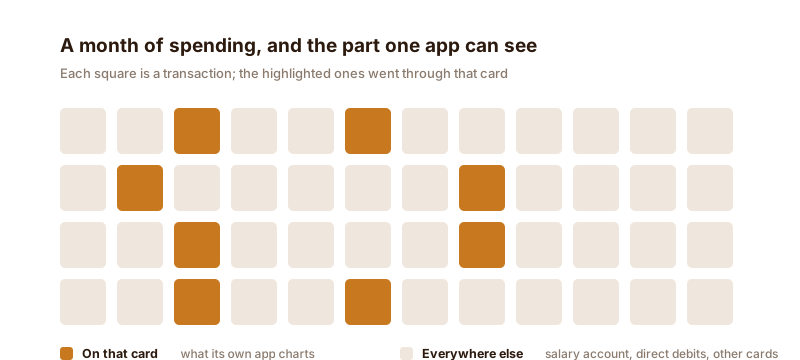
The categories that matter most for a decision — housing, insurance, debt, subscriptions — are precisely the ones sitting on the other account. They are also the ones that recur, which is what makes them worth finding.
Four things a single-account view can’t do
Show your real category totals. Groceries split across two cards read as two half-sized numbers, neither of them the answer. You cannot fix this by adding them up in your head, because you never see them together to know they need adding.
Tell income from transfers. Money you move from your main bank into Revolut arrives looking like income. Spend it and it is counted once as a transfer in and once as spending, so both sides of the ledger are inflated. This is the single most common distortion in any single-account report, and it is worst exactly where people use a second card for budgeting.
Find the subscriptions. Recurring charges scatter by design — the app-store ones on one card, the insurance on another. A per-account list finds a subset and gives no signal that it is a subset.
Anchor to net worth. Spending only means something against what you have. A card balance is not that number, and it moves for reasons that have nothing to do with your finances.
Where it is genuinely the right tool
Being fair about this matters, because Revolut does several things an aggregated view does not:
- Instant categorisation as you spend. The notification arrives already sorted. Nothing reading your accounts through open banking can beat a bank at speed on its own transactions.
- Per-merchant history inside the account. “What have I spent at this place since 2023” is a good question and it answers it well.
- Currency. If you spend in several currencies, its own reporting handles that natively.
- Card controls. Freezing, limits, virtual cards. Nothing external touches this.
None of that is in tension with seeing everything together. They are different jobs.
What “everything together” actually requires
The technical answer is open banking: a licensed connection that reads transactions from each bank with your consent, and never has the ability to move money. Revolut is one of the accounts it can read, alongside the main bank, and both arrive in the same categorised list. Is it safe to connect your bank to an app covers what that consent does and does not permit.
The practical answer is that you connect the accounts once and stop thinking about which card something was on. Your grocery total is your grocery total. The subscriptions list is all of them. The monthly picture is the actual month.
If you are running the common Portuguese setup — a main bank for the salary and the standing orders, Revolut for everything else — using Revolut next to your main bank works through why that split makes sense and what it costs you in visibility.