
Wallet, Spendee, Money Manager — when manual entry stops working
The manual expense apps are well built and most people stop using them within two months. The reason is the same one that kills the spreadsheet, and it decides which tool you should pick.
By António Avelar Updated 22 August 2026 4 min read
Wallet, Spendee, Money Manager, Monefy, Toshl and a dozen others are, as software, good. The interfaces are clear, the charts are honest, the categories are sensible, and several have been maintained for a decade. If they failed on quality this article would be much shorter.
They fail on something else: the product is you typing. And the typing is the part that stops.
Three ways a tracking app gets its data
Every app in this category sits in one of three places, and the difference matters more than any feature list.
| How it works | What you do each week | Where it breaks |
|---|---|---|
| Manual entry | Type each purchase as it happens, or reconstruct it later | Any busy week; a three-week backlog is never cleared |
| Import a file | Download a statement per account, upload, map the columns | Quietly, when one month gets skipped and the totals stop being comparable |
| Bank connection | Nothing | Rarely — a connection needs re-authorising every 90 days |
Most of the well-known names are in the first row. Some offer imports on a paid tier. A smaller group connects to banks directly, and in Europe that means open banking.
Why entry-based tracking has a half-life
It is not motivation. It is that the effort and the reward are in the wrong order.
Entering transactions costs you something every single day, and pays you nothing until the end of the month when the chart appears. Worse, the cost scales with exactly the thing that makes you busy: a heavy month is a month with more transactions to type, arriving at the moment you have least appetite for it.
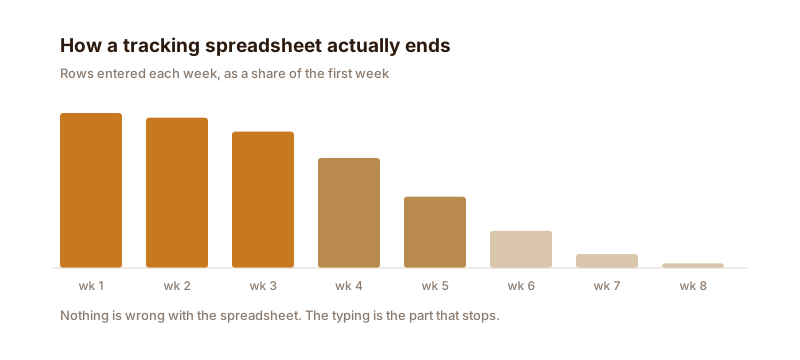
Once you are behind, you face a decision: spend ninety minutes reconstructing three weeks from memory and a statement, or accept that the data is broken and start again next month. Almost everyone starts again next month, twice, and then stops.
The second failure is subtler and worse, because it happens while you are still using the app. Manual entry means you decide the category at the moment of typing, and you decide it slightly differently each time — the pharmacy is health this month and errands next month. After a few months the totals are no longer comparable to each other, which is the only thing they were for.
When manual really is the right answer
Two cases, and they are real:
Cash-heavy spending. If a meaningful share of your money moves as physical cash, no connection can see it and typing is the only way it exists in your records at all.
You do not want to connect anything. A perfectly legitimate position. If you would rather no software read your accounts, manual entry or a spreadsheet is the honest choice, and it is better than an abandoned connection.
For everyone else, the test is simple: look at your app now and count the days since the last entry. If it is more than four, the app is not being used, whatever the install count says.
What to look for instead
If you are switching, the thing to check is not the chart quality. It is:
- Does it read your accounts, all of them? One connected account is the same problem as before with a different logo. Multiple banks in one place is the point.
- Does it name the merchants? A feed of
CT 4471 LISBOA 0821is not tracking, it is homework. Turning terminal codes into recognisable names is most of the work. - Are the categories yours? A fixed category list from someone else’s idea of a life is the thing that made your old totals meaningless. Categories that match how you actually live is what makes month-to-month comparison possible.
- Does it survive a bad month? The only real test. A tool that needs nothing from you in a week where you have nothing to give is the only kind that is still there in March.
If you want the wider comparison rather than this one category, choosing a personal finance app in Portugal sorts the market into its four kinds before you commit.